


Why ‘job hugging’ is impacting hiring managers and leaders
August 26, 2026
First was the great resignation, then quiet quitting. Now it seems that job hugging is trending. Job hugging is when an employee stays in their current role out of fear rather than engagement.
We discuss the specific challenges job hugging is creating for leaders and hiring managers and look at ways to overcome them.
Job mobility has declined in the last year and a key reason is job hugging. This is the tendency of unhappy or unfulfilled employees to cling to their current role, not because they love it, but because they fear the alternative.
Why is this trending now? Like in other times of economic uncertainty and lower job creation, employees prioritise stability and safety. When combined with AI-driven anxiety, whether due to potential job loss or skill gaps, and the diminishing pay-off for moving organisations, job hugging has become common practice.
Job hugging, by the numbers
The mobility numbers paint a clear picture of job hugging, with one exception. Professional, scientific and technical services stand out as outliers, yet higher mobility may say less about appetite for change than about mechanics: project-based pipelines naturally cycle people between roles, and recent changes to the definition of casual employment have wound up many long-term contract arrangements, forcing those workers to move.

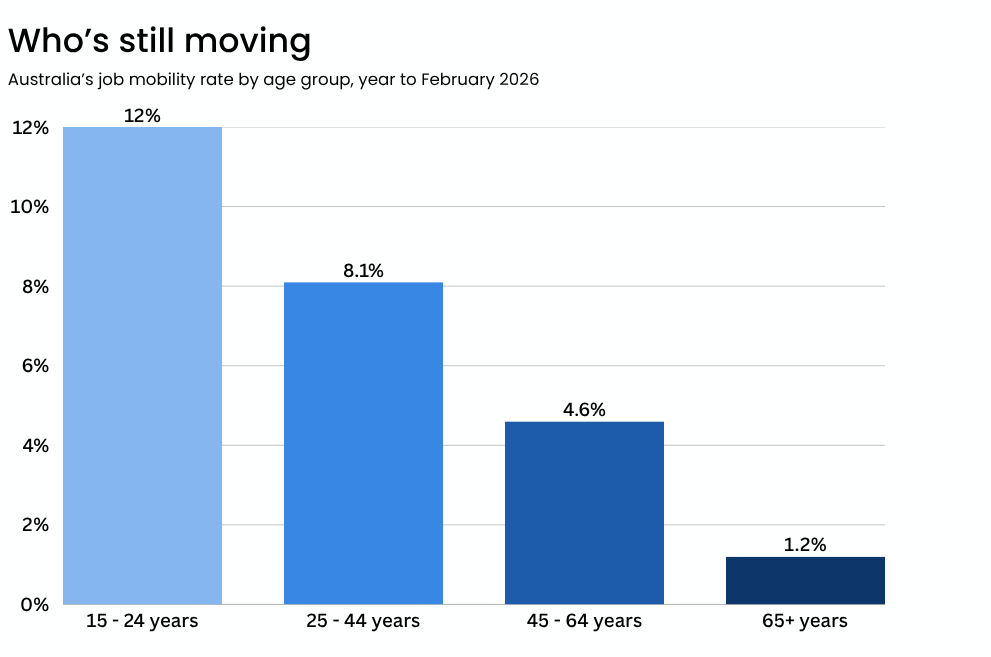
After the Northern Territory, Queensland and South Australia are experiencing the highest movement of 8.2%, with the lowest mobility in Victoria at 6.9% and New South Wales at 6.5% respectively. The difficulty in attracting experienced professionals is also made clear when considering the decline in mobility by age group.
Challenges for leaders
Job hugging may provide a false narrative for retention. Low turnover can mask real disengagement. If you have enough employees who've mentally checked out but are staying anyway, it can reduce motivation, productivity and innovation across the organisation. Further to this, some employees may be underutilised.
It also creates an internal blockage problem. When nobody leaves, promotion opportunities don’t exist, so your best people can get stuck behind disengaged colleagues. That frustration builds quietly and then surfaces all at once, often as a wave of resignations the moment the job market improves. The latest job mobility figures in Australia are some of the lowest on record but won’t stay this way forever.
Job hugging is often paired with, and sometimes confused with quiet quitting, but they are different. Quiet quitting is about effort; employees withdraw discretionary work, setting boundaries in response to burnout. Job hugging is about tenure; employees withdraw from the job market, not from the job itself.
Recruitment challenges for hiring managers
With less people moving on and administrative staff not being recruited due to AI, new people are not entering the business. This means new ideas, new energy and new dynamics are less prevalent, which can create stagnation.
It also affects the broader market. With fewer talented people willing to move, competition for available candidates is stronger. Internal counteroffers are disrupting recruitment timelines, with more candidates withdrawing late in the process and choosing what feels like the safer option. This is where Bayside Group can advocate for your organisation and help secure top talent. Counteroffers can be a trap so organisations need to provide pathways to support internal movement, including lateral moves.
For organisations to grow and thrive, bringing in new talent is beneficial long-term. The cohort not hired now becomes the experienced mid-level talent gap in three to five years, a cost that can have significant implications for your organisation.
Minimising job hugging impacts
Markets like this are not permanent, so it’s important to build engagement, real internal mobility pathways, and a steady entry-level pipeline. Employers can shift the "stay" from fear-driven to genuinely motivated with a few concrete levers.
- Redefine growth beyond promotion. With fewer open roles to promote into, offer lateral moves, stretch assignments, secondments, and skills-based development.
- Make internal mobility visible and easy. Build a transparent internal job so employees have opportunities to grow and move.
- Have regular, honest career conversations. Don't wait for a resignation to ask what someone wants next, frequent one-on-ones about aspirations catch disengagement before it hardens.
- Reward skill growth in pay, not just promotion. Modernise compensation so new capability or added responsibility if reflected in their pay, even without a title change.
- Watch engagement, not just retention. Track sentiment and effort separately from headcount stability.
- Keep performance management sharp. Be clear on expectations and nurture people to reach them.
- Protect strategic hiring. Resist freezing hiring intakes entirely, but instead strategically hire to bring in fresh ideas and specific skill sets that can’t quickly be realised through training.
Those organisations that read low turnover as high satisfaction will find out the difference all at once, in the resignations that follow.
If you are
looking for talent or would like to know more about the current market,
get in touch.

Since the definition of casual employment changed in 2024, employers are hiring less casuals, with permanent staff left to carry the workload.

When an employee works from home, employers are responsible for managing work related health and safety risks. Here we outline employer safety obligations.

Obligations relating to final entitlements when employees leave the company are often misinterpreted. Workplace Relations expert, Dean Sherriff, explains what to do.